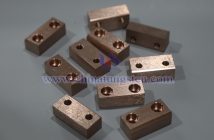
Tungsten beads, mainly made of high-density tungsten alloy, are used as counterweights or rotor materials in aerospace gyroscopes. Their core function is to improve system stability, accuracy, and reliability.
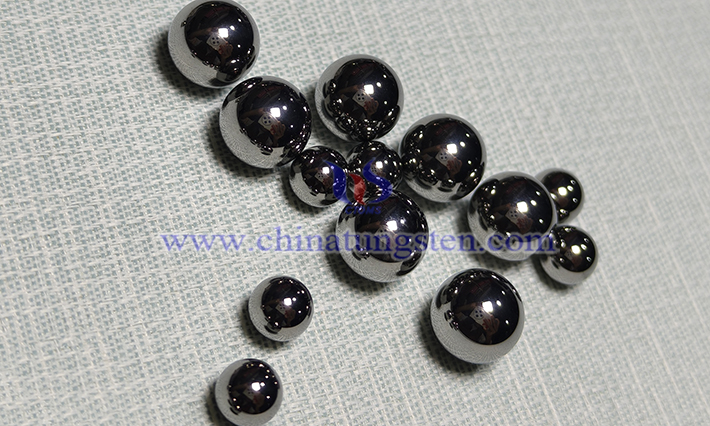
I. Applications of Tungsten Beads as Counterweight Materials
1.1 Balance and Stability Optimization: The high density of tungsten alloys makes them ideal counterweight materials. In aerospace gyroscopes, counterweights adjust the center of gravity distribution of the rotor or control system to compensate for manufacturing deviations or dynamic imbalances, ensuring uniform rotor rotation and reducing vibration and pre-precession. For example, in aerospace gyroscopes, tungsten alloy counterweights can store the kinetic energy of a rotating flywheel or adjust the oscillation frequency of a laser beam; in satellite applications, they ensure balance during orbital insertion and maintain reliable system operation under extreme conditions.
1.2 Anti-interference and Accuracy Improvement: Tungsten alloy counterweights, by optimizing the center of gravity position, generate sufficient moment of inertia, improving the sensitivity and control accuracy of the gyroscope. Their high elastic modulus enhances structural rigidity, resulting in excellent vibration damping and effectively suppressing rotor deviation. Furthermore, the magnetism of tungsten alloys can be tuned to weak or non-magnetic, avoiding interference with precision systems and further improving measurement accuracy.
1.3 Adaptability to Extreme Environments: The high melting point (approximately 3410℃) and low coefficient of thermal expansion of tungsten alloys provide excellent dimensional stability at high temperatures, preventing softening and deformation; high hardness and mechanical strength offer excellent impact resistance and wear resistance, adapting to high dynamic load conditions. These characteristics make tungsten alloy counterweights an ideal choice for long-term on-orbit operation of spacecraft.

II. Application of Tungsten Balls as Rotor Materials
2.1 Stability Requirements for High-Speed Rotation: Aerospace gyroscope rotors need to operate stably for extended periods at high speeds of tens of thousands of revolutions per minute, requiring extremely high material density, strength, and wear resistance. Tungsten alloys, due to their high density and high hardness, are the preferred rotor material. For example, the rotor of an aircraft yaw gyroscope is made of tungsten alloy. It maintains axial stability through high-speed rotation and, in conjunction with an outer ring shaft and a correction torque system, measures the change in yaw angle during aircraft turns in real time.
2.2 High Temperature Resistance and Long Lifespan Design: Tungsten alloy rotors generate a large amount of heat during high-speed rotation, requiring materials with excellent high-temperature resistance. The high melting point and thermal stability of tungsten alloys ensure that the rotor does not deform at high temperatures. Simultaneously, its wear resistance extends the rotor's lifespan, reduces maintenance requirements, and lowers spacecraft operating costs.
2.3 Potential Applications in Microelectromechanical Gyroscopes (MEMS): With the development of MEMS technology, tungsten alloys, due to their high density, may be used in the vibration elements or counterweight structures of miniature gyroscopes. By optimizing mass distribution, the accuracy of angular velocity measurement can be improved, meeting the spacecraft's demand for miniaturized, high-precision inertial sensors.